


Keep the Ball Rolling: Simplifying Session Design and Stripping Away Over-Coaching


Last night, we held a coach development session that reminded me of a fundamental truth in Canadian soccer development: better coaching isn't about making things more complex—it’s about bringing clarity to the message.
I had the privilege of co-facilitating a session alongside a guest coach.
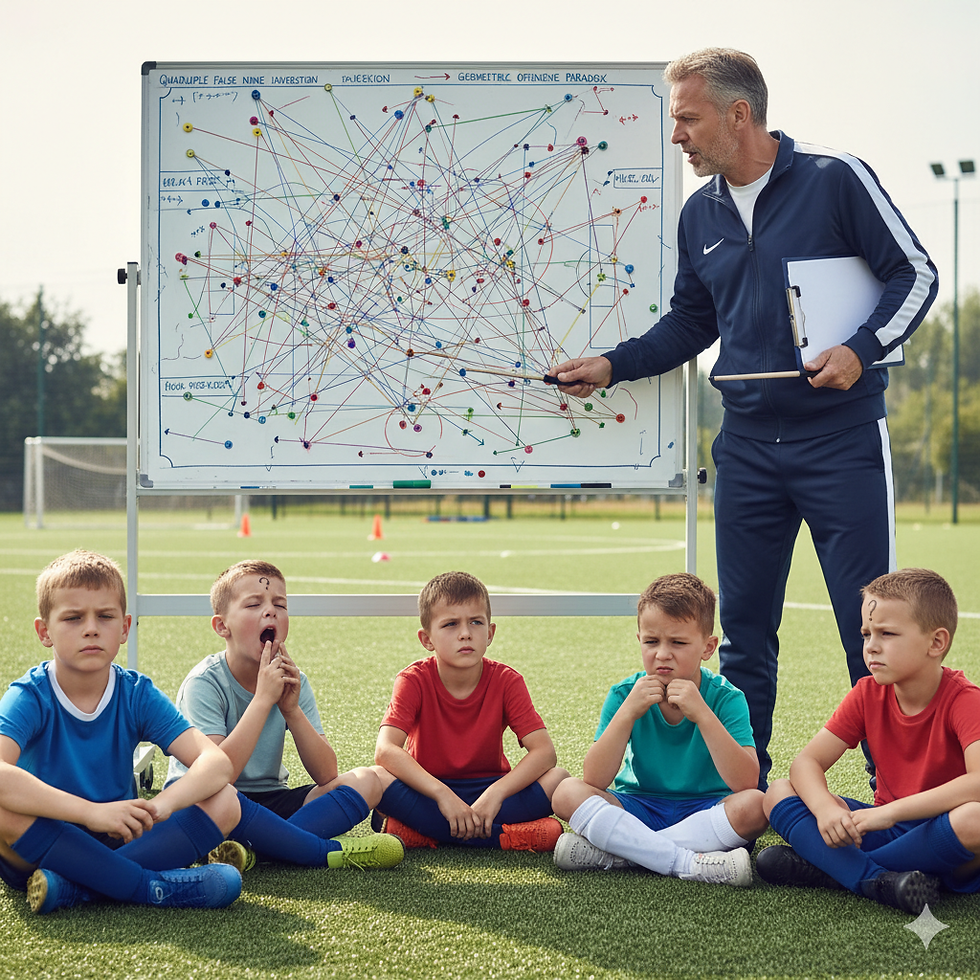
If you’ve ever found yourself spending two hours drawing beautiful 3D session diagrams with multi-colored cones, only for the session to fall apart five minutes in, this reflection is for you.
1. Write It Down, Keep It Simple
You don’t need high-end graphic design software to build a great session. You don’t need a perfectly rendered 10-page PDF. But you do need a plan.
Winging it on the pitch is a disservice to the players. Grab a notepad, grab a whiteboard, write down your key objectives, and map out your space. Control the controllables of your environment before the players ever set foot on the grass.
When your setup is organized, your energy stays focused where it belongs: on observing and guiding the players.
2. Anchor Everything to Your Game Model
Before you pick a drill, ask yourself: How do we actually want to play?
Your game model doesn’t need to read like a UEFA Pro License thesis. Keep it straightforward. For example, one of your guiding principles: "We are a team that wants to dominate possession."
Even when you are working on defending, that core identity dictates your defensive behaviors.
If our goal is to get the ball back to dominate possession, what does our shape look like when the opponent has a goal kick?
What are our distances between lines?
What specific behaviors do we want to see—where, when, and how do we press to win it back?
When every exercise connects back to a simple, shared principle, players start connecting the dots themselves.
3. Keep the Ball Rolling (No Over-Coaching)
One takeaway from last night’s pitch session came down to tempo and discipline—not the players’ discipline, but our discipline as coaches.
It is so easy to fall into the trap of over-coaching. We freeze the play every ninety seconds, lecture for three minutes, and kill the rhythm of the game.
Deliver ONE clear message. Repeat it consistently throughout the session.
Keep the ball rolling. Players learn by doing, adapting, and feeling the game—not by listening to us talk under a floodlight.
Filter what you address. You will see a dozen things going wrong on the pitch. Resist the urge to fix all of them at once. Stick to your session’s focus, and address the rest later.
The Debrief: Meeting Coaches Where They Are
The post-session reflection was a great conversation. Because the message delivered on the pitch was simple and repeated, the players were fully engaged the entire time.
During the debrief with our local coaches, we could see the building of their own plans. Questions and conversations to ground the information and example into their environment. Dealing with their reality, players, and understanding of the game. Reinforcing the message that there is no one right way for everything. It’s not about repeating what we saw, it's about learning from it, reflecting on it and working this into their sessions and plans.
When coaches leave a mentorship session feeling energized rather than overwhelmed, you know you’ve hit the mark.
Our job isn't to show players or coaches how much we know. Our job is to create the parameters where learning happens naturally. Write the plan, keep the ball rolling, and let the environment do the heavy lifting.
In some cases, it won’t work, your plan will fail. That’s not a problem, only information. Reflect, adapt, recognize that the most important part can still be accomplished. They had fun, they are looking forward to coming back. We will fall down, we will have sessions that do not flow, we will have bad days.
Everyone is allowed to fail, as a coach mentioned in our debrief “There is no learning without failure.”
It’s what we do next that matters. Write it down, ask questions, reflect, be curious and adapt the plan.
Coach's Reflection Checklist for Your Next Session
Question to Ask Yourself | The "Player-First" Standard |
Is it written down? | I have a clear, written plan that controls my space and setup before players arrive. |
Is the principle clear? | The objective connects directly to how we want to play (e.g., shape and press on goal kicks). |
Is the ball moving? | Active playing time heavily outweighs coach talking time. |
Am I over-coaching? | I am coaching only my primary message and letting non-essential mistakes go for now. |


Comments