


"Joysticking" the Game: Why Context is King in Youth Development

By Lindsay van Kessel (The Main Grump)

We have a problem on our youth sidelines. We are obsessed with control.
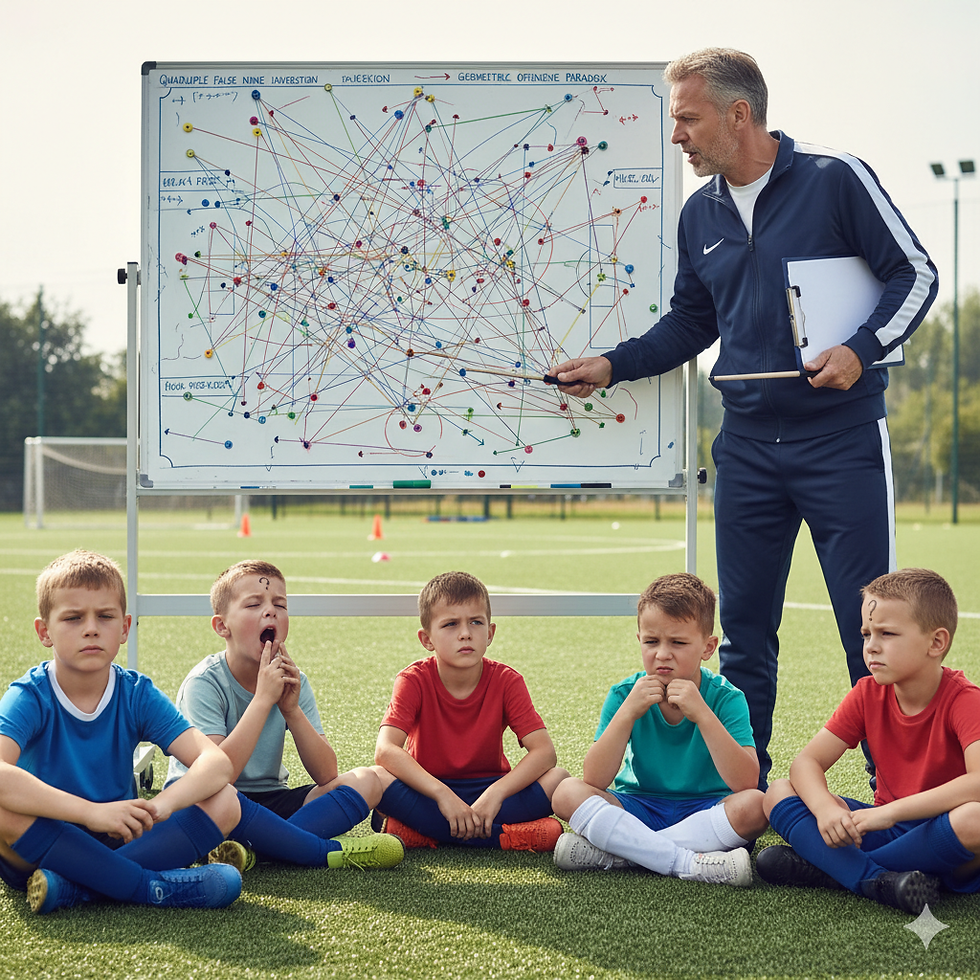
As coaches and parents, we love to play "Joystick FC."
Let’s be honest, if we could control the game with our minds, we very likely think things would go much better. But then it’s not the players' game is it?
We scream instructions like "Pass!", "Shoot!", or "Get wide!" because, from our view on the touchline, the solution looks obvious. When a player misses a pass or dribbles into a wall, we sigh and wonder why they "made the wrong decision."
But recently, I read a fascinating paper by Mark O'Sullivan, Matías Manna, and Keith Davids called Applying an Ecological Framework to Football Analysis. It’s heavy on the science, but the message is simple and critical for us to hear: We are judging players based on what we see, not what they feel.
If we want to build better training environments and support real growth, we need to stop imposing our view on the kids as the only solution and start understanding theirs.
"The Televised Eye View" vs. The Player’s Reality
The article distinguishes between two types of knowledge:
Knowledge ABOUT the game: This is what we (coaches/parents) have. We see the whole field, the formations, and the patterns. It is detached and observational.
Knowledge OF the game: This is what the player has. They are in the storm. They feel the pressure of the defender, the bobble of the ball, and the fatigue in their legs.
When we scream "Pass to Johnny!", we are using Knowledge About. We see Johnny is open. But the player on the ball might not perceive that option because they are managing a 200lb defender breathing down their neck. They are relying on Knowledge Of—the direct, lived experience of the moment.
The Lesson: Stop judging a player’s decision based on what you saw from your outside view. You aren't playing; they are. As coaches, we struggle with this as well.
Decoding "Mental Performance": It’s Not Just About Toughness
We often talk about mental performance in youth soccer as "grit" or "focus." But this ecological approach suggests a different definition: Attunement.
A player’s "football intelligence" isn't a static stat like in a video game (e.g., Passing: 85/100). Intelligence is the ability to couple perception with action. It is about how well a player scans their environment and finds an "affordance"—a fancy word for an opportunity for action.
Example: A gap between two defenders isn't just empty space.
To a fast, aggressive winger, that gap is an invitation to dribble.
To a thoughtful midfielder, that gap is an invitation to pass.
Both are "right." The decision depends on the player’s unique capabilities and their intent in that split second.
Mental performance, then, is the ability to stay connected to these cues without interference. When we scream constant instructions, we aren't helping them focus; we are likely only noise. We are severing their connection to the game. We train them to listen to us instead of reading the game.
How to Build a Better Environment (For Coaches)
If we want players to transfer training skills to game day, we have to stop treating them like chess pieces.
Design, Don’t Dictate: Instead of stopping play every 30 seconds to lecture, create session environments where the game forces the decision. If you want them to play faster, shrink the field. If you want them to scan more, add a recovering defender or attacking player from a different angle. Let the environment provide the problem for them to solve in multiple ways.
Value "Intent" Over "Outcome": If a player tries a through-ball and it gets cut off, please don’t shake your head and yell or correct. Ask yourself: What did they see?
They likely saw a shared affordance—a moment where they and a teammate connected. That "failure" is actually a sign of high-level thinking.
Here is what actually happened:
They saw a solution.
They used that "affordance" to link their perception to an action.
The execution failed this time.
But here is the magic: Now they know more. The outcome of that "failed" pass provides the data that influences their future perception. They are calibrating their radar.
If you scream at them for the turnover, you aren't correcting a mistake; you are short-circuiting their learning loop. You are telling them to stop scanning for opportunities and start playing safe. And safe players don't grow. Play safe when it makes sense to, take risks when it makes sense to, try new things, see what you can do.
The "Linking Coach": The article suggests moving from an "analyst" role to a "relational" role. Your job isn't to impart wisdom from on high; it's to facilitate shared understanding. Ask players, "What did you see there?" rather than telling them "You should have done X."
Helping them to realize that they can provide solutions, make mistakes, but hold them accountable for the learning in that moment. “That pass didn’t work but the idea was great. What can you change to make it successful?” And, you don’t need them to tell you the answer, you need them to show you a solution.
How to Watch the Game (For Parents)
This is the hardest part. You want your kid to succeed. But "helping" them with loud instructions is actually hurting their development. Let’s think about our roles away from the kids. How do we best learn new tasks in our jobs? What is that environment like when we learn new things and enjoy it? The player's job is to be a kid and develop, how do we support that.
Silence is Golden: Let them solve the puzzle. Every time you solve it for them, you rob them of a rep. We know repetition can help with learning, if the school only ever told the kids the answers and not how to get there, what would their problem solving skills look like?
Cheer the Intent: Did your child look up and try to switch the field, even if the ball went out of bounds? Cheer that. That shows they are reading the game (perception-action coupling). The technique will catch up; the vision is what matters. “Great idea! Next time!” This can encourage them not to give up on building that skill.
Understand Their "Worldview": Every kid sees the game differently based on their history and confidence. A kid who is afraid of making mistakes (perhaps because they feel judged for performance and results) will stop seeing opportunities to attack and only see opportunities to hide. A player who is thinking “I hope this works.” vs “I am going to make this work.”
The Bottom Line
Football isn't a script to be memorized; it's a conversation between the players, the pitch, the environment and the ball.
The article puts it perfectly: “Innovation risks becoming hollow: like passing without purpose, technically correct, but emotionally empty.”
Nothing is ever perfect, no one solution fits every time for every player. Let’s start raising footballers who can feel the game, read the chaos, and make decisions that belong to them, not us.
Hold them accountable for the reflection, not just the result. Let them own their path. Passive acceptance of a result—whether it was a goal or a turnover—is not enough. If they make a decision, they must be willing to analyze it.
Your role is to guide that discovery, not dictate it. Ask them what they saw. Dig into their questions. Be curious with them, not grumpy at them.
See you on the pitch and let's cheer on their ideas!

Comments